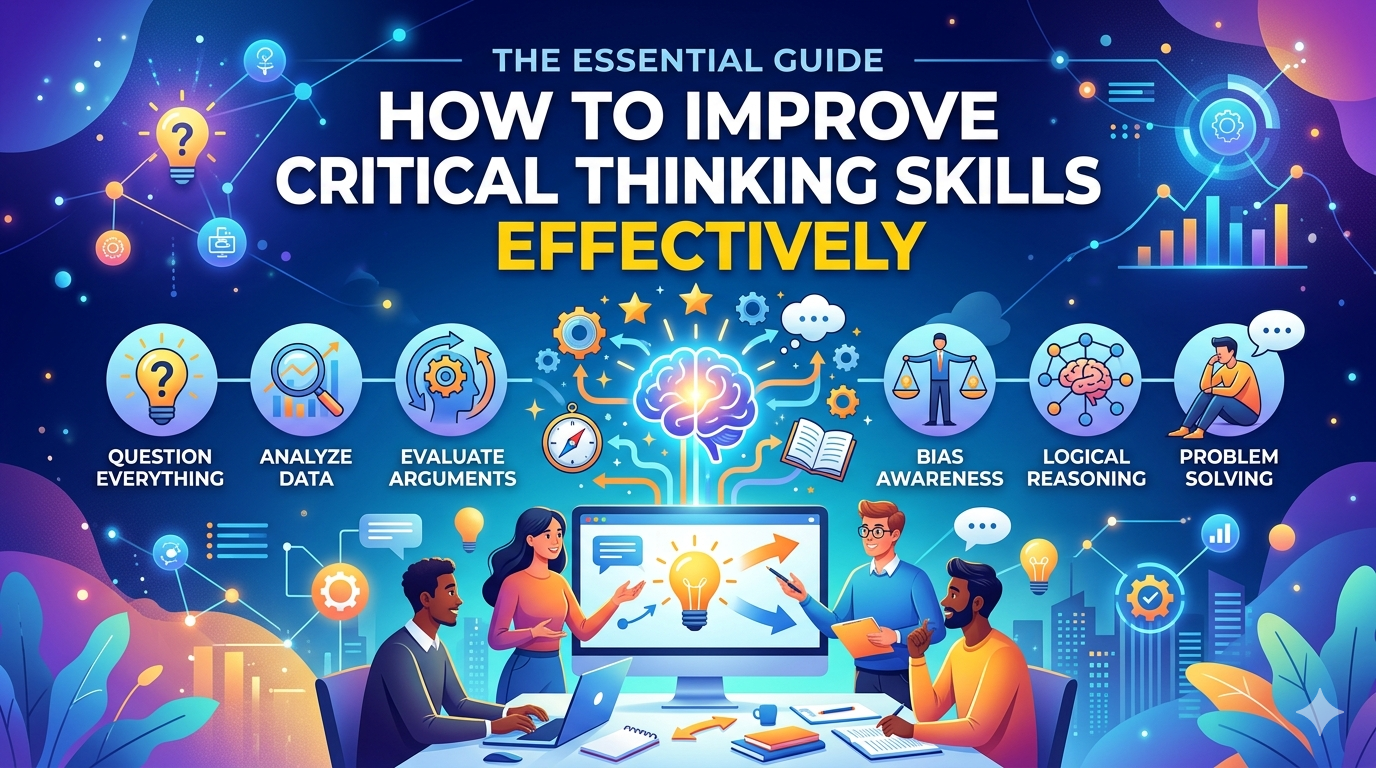
How to Improve Critical Thinking Skills?
Critical thinking is one of the most valuable skills in today’s fast-paced world. It helps you analyze information, make better decisions, and solve problems effectively. Whether you are a student, professional, or entrepreneur, improving your thinking ability can give you a strong advantage. In this article, we will explore proven strategies, habits, and critical thinking exercises that can help you sharpen your mind.
What is Critical Thinking?
Critical thinking is the ability to think clearly, logically, and independently. It involves analyzing facts, evaluating arguments, and forming reasoned judgments. Instead of accepting information at face value, critical thinkers question assumptions and look for evidence.
People with strong critical thinking skills are better at:
- Solving complex problems
- Making informed decisions
- Avoiding bias and misinformation
- Communicating ideas effectively
Why is Critical Thinking Important?
In today’s digital age, we are constantly exposed to massive amounts of information. Not all of it is accurate or useful. This is where critical thinking plays a crucial role.
Improving your thinking skills helps you:
- Make smarter life and career choices
- Understand different perspectives
- Avoid manipulation or false information
- Increase creativity and innovation
By practicing critical thinking exercises, you can train your brain to process information more effectively.
1. Practice Active Learning
One of the best ways to improve critical thinking is by becoming an active learner. Instead of passively reading or listening, engage deeply with the material.
Ask questions like:
- Why is this important?
- What evidence supports this claim?
- Are there alternative viewpoints?
Taking notes, summarizing information, and discussing topics with others can strengthen your understanding and improve your thinking skills.
2. Use Critical Thinking Exercises Daily
Critical Thinking Exercises for Beginners
If you want to build strong thinking habits, start with simple critical thinking exercises. These exercises challenge your brain and improve reasoning skills.
Examples include:
- Solving puzzles and brain teasers
- Playing strategy-based games
- Analyzing case studies
- Debating different viewpoints
Doing these regularly will help you develop a logical and analytical mindset.
3. Question Assumptions
Many people accept information without questioning it. Critical thinkers do the opposite—they challenge assumptions.
Whenever you encounter a statement, ask:
- Is this fact or opinion?
- What evidence supports it?
- Could there be bias?
This habit helps you avoid false conclusions and improves your decision-making ability.
4. Improve Your Observation Skills
Observation is a key part of critical thinking. Pay attention to details in your surroundings, conversations, and information sources.
Try this:
- Observe a situation carefully
- Identify patterns or inconsistencies
- Draw conclusions based on evidence
Strong observation skills enhance your ability to analyze situations accurately.
5. Engage in Discussions and Debates
Talking with others is a powerful way to improve your thinking skills. Discussions expose you to different perspectives and challenge your ideas.
When engaging in conversations:
- Listen actively
- Respect different opinions
- Support your arguments with evidence
Participating in debates is one of the most effective critical thinking exercises to sharpen reasoning and communication skills.
6. Develop Problem-Solving Skills
Critical thinking and problem-solving go hand in hand. Whenever you face a problem, follow a structured approach:
- Identify the problem
- Gather relevant information
- Analyze possible solutions
- Choose the best option
- Evaluate the results
Practicing this method regularly improves both your logic and decision-making abilities.
7. Read Widely and Critically
Reading books, articles, and research papers exposes you to new ideas and perspectives. However, simply reading is not enough—you must read critically.
Ask yourself:
- What is the main argument?
- Is the source reliable?
- Are there any biases?
This habit strengthens your analytical skills and helps you think independently.
8. Reflect on Your Thinking
Self-reflection is an essential part of improving critical thinking. Take time to analyze your own decisions and thought processes.
Consider:
- Did I make a logical decision?
- What could I have done differently?
- Was I influenced by bias?
Reflection helps you identify weaknesses and improve over time.
9. Apply Critical Thinking in Real Life
Advanced Critical Thinking Exercises
To truly master critical thinking, apply it in real-life situations. Advanced critical thinking exercises include:
- Evaluating news articles for credibility
- Analyzing business decisions
- Solving real-world problems
- Making data-driven choices
The more you apply these skills in everyday life, the stronger they become.
10. Stay Curious and Open-Minded
Curiosity drives critical thinking. Always be eager to learn and explore new ideas.
At the same time, stay open-minded:
- Accept that you may be wrong
- Be willing to change your opinion
- Consider different viewpoints
This mindset encourages growth and deeper understanding.
Common Mistakes to Avoid
While improving your thinking skills, avoid these common mistakes:
- Jumping to conclusions
- Ignoring evidence
- Letting emotions control decisions
- Relying on assumptions
By avoiding these pitfalls and practicing critical thinking exercises, you can develop a more rational and balanced mindset.
Final Thoughts
Improving critical thinking skills is a continuous process that requires practice and dedication. By adopting habits like active learning, questioning assumptions, and engaging in discussions, you can enhance your ability to think clearly and make better decisions.
Incorporating critical thinking exercises into your daily routine will strengthen your reasoning, boost your confidence, and help you succeed in both personal and professional life.
Start small, stay consistent, and watch your thinking skills grow over time.