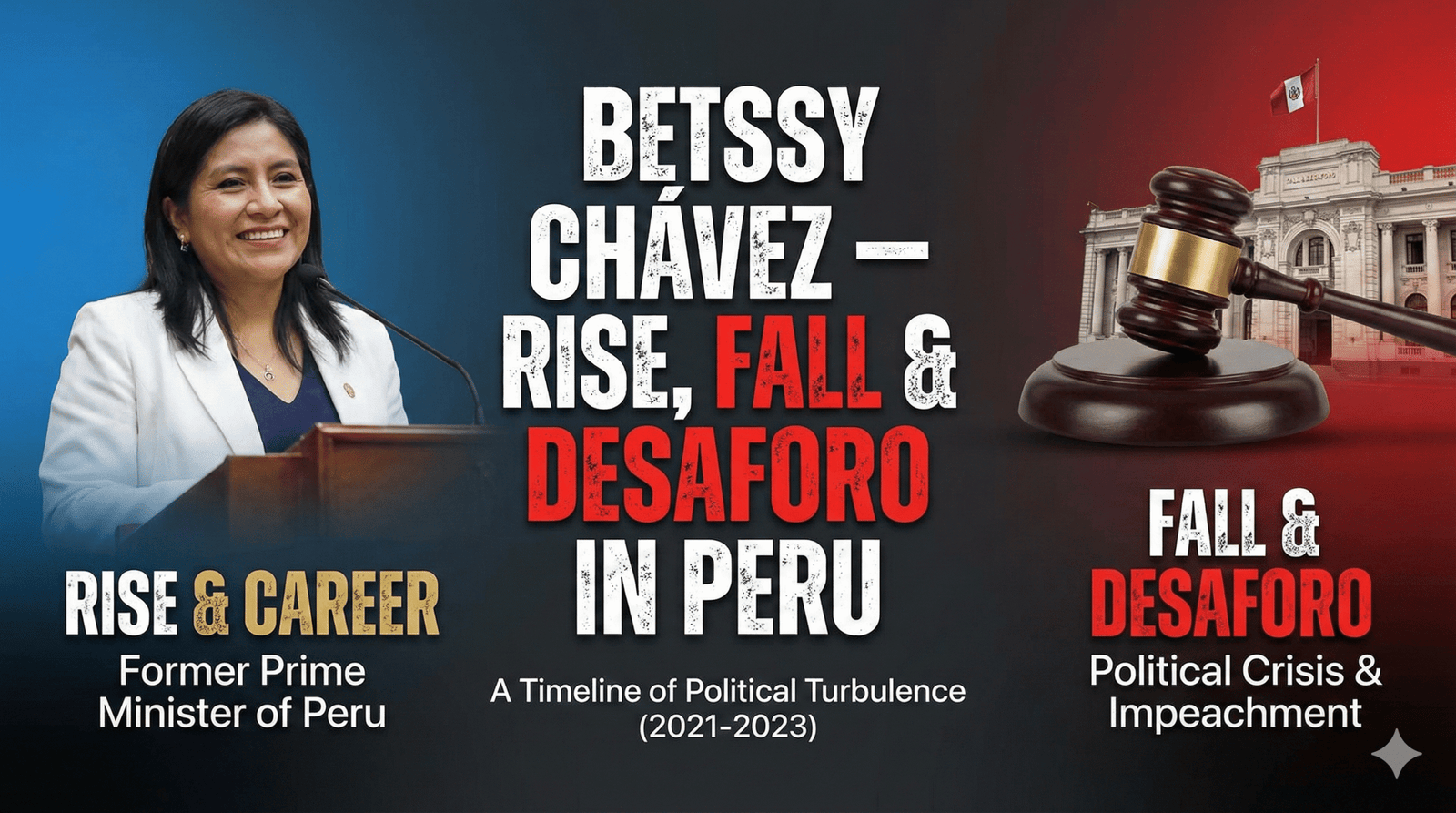
Betssy Chávez: From Political Rise to “Desaforan a Betssy Chaves” Crisis
Who Is Betssy Chávez?
Betssy Chávez (full name: Betssy Betzabet Chávez Chino) is a Peruvian lawyer-turned-politician who rose rapidly through political ranks. Born on June 3, 1989 in the Ciudad Nueva District, Tacna, she studied law and later constitutional law, entering politics as a student activist and eventually working for Congress in various advisory capacities.
Her rise in politics culminated in appointments to ministerial positions and — briefly — to the nation’s premiership. She became one of Peru’s youngest and most prominent female political figures.
Quick Facts Table
| Attribute | Details |
|---|---|
| Full Name | Betssy Betzabet Chávez Chino |
| Date of Birth | June 3, 1989 |
| Profession | Attorney, Politician |
| Political Roles | Member of Congress, Minister of Labor, Minister of Culture, Prime Minister of Peru |
| Prime Minister Term | November 26 – December 7, 2022 (about 12 days) |
| Political Party / Affiliation | Formerly with party tied to then-President Pedro Castillo; later parliamentary shifts. |
| Current Status (2025) | Stripped of parliamentary immunity; under legal proceedings and reportedly detained / under pretrial restrictions. |
Political Career & Rise
- Early Involvement & Congress Entry: Chávez began in student politics and later worked as an advisor/assistant in congressional offices. Her early engagement with political activism laid a foundation for her later career.
- Ministerial Roles: She held key cabinet positions — first as Minister of Labor, then as Minister of Culture — before being elevated to head of the cabinet (Prime Minister), reflecting her swift ascent.
- Premiership: On November 26, 2022, she became Prime Minister, making her among the few women in Peru’s history to hold that post. Her premiership, however, lasted only until December 7, 2022.
Her rise was viewed by supporters as the ascension of a young, dynamic woman determined to lead with reformist ambitions.
What “Desaforan a Betssy Chávez” Means — The Downfall
The phrase “Desaforan a Betssy Chávez” refers to the legal and political process whereby she was stripped of parliamentary immunity, a step that allows prosecutors to formally pursue criminal charges against a former high-ranking politician.
Key Events Leading to the Desafuero
- On December 7, 2022, a major political crisis erupted when then-President Pedro Castillo attempted to dissolve Congress — widely considered an attempted coup. Chávez’s short premiership ended amidst this upheaval.
- On March 22, 2023, Congress moved to suspend her immunity, opening the door for criminal investigation into her alleged role in the events. The vote passed with a significant majority.
- She was replaced in Congress shortly afterward, marking a dramatic and rapid fall from power.
This turn of events shocked many within Peru and beyond, as she had been a symbol of youth and female political ascension.
Legal Proceedings, Controversies, and Detention
Following her desafuero:
- She was detained under preventive custody while investigations proceed, accused of serious offenses including alleged rebellion or conspiracy linked to the coup attempt.
- During a court transfer in April 2025, she reportedly suffered a health episode (a collapse) en route to a trial hearing.
- Human rights and justice-process questions have arisen, with critics citing lack of transparency, possible political motivations behind the charges, and concerns over due process.
- An official parliamentary recommendation has been filed to ban her from holding public office for 10 years if found culpable in the attempted coup case.
Her story has stirred debate about whether the legal actions are genuine accountability measures—or political persecution.
Political Context & Impact
- The fall of Betssy Chávez reflects wider political instability in Peru. Her rapid rise and even swifter downfall illustrate how volatile Peruvian politics have become in recent years.
- For many supporters, her case symbolizes a warning: that even high-ranking politicians (and especially women) may not be immune to legal backlash if power shifts.
- The process has raised serious questions about the use of “desafuero” as a tool — whether it’s being used for justice or as a political weapon to silence opposition and dissent.
Her story has resonated beyond Peru, drawing attention from human-rights observers concerned about fairness, due process, and political rights in times of crisis.
Public Perception & Gender Dimension
- Public opinion is sharply divided: some view her as a symbol of corruption and instability; others defend her as a victim of political retribution.
- As a young woman who reached high office, Chávez had been celebrated as a sign of progress. Her fall — under dramatic circumstances — has triggered discussions about gender, power and protection of female politicians in volatile political contexts.
- The heavy scrutiny of her personal relationships and alleged nepotism contributed to broader controversies that preceded the legal actions — complicating public perceptions and fueling debate over fairness and accountability.
Current Status & What’s Next
- As of late 2025, an international arrest warrant has been issued for Betssy Chávez after she reportedly sought asylum at the embassy residence of Mexico Embassy in Lima.
- Legal proceedings continue; a vote on her political ineligibility (10-year ban) is pending as part of the broader judicial and congressional process.
- The ultimate outcome remains uncertain — whether she will face trial, exile, or possible exoneration — but her case is already being seen as a turning point in modern Peruvian politics.
Conclusion
Betssy Chávez’s trajectory — from young lawyer and student activist to Peru’s cabinet minister and briefly Prime Minister — seemed emblematic of progress and hope for many. However, the dramatic events of December 2022 and subsequent “desafuero” have turned her story into a cautionary tale: one about political volatility, the fragility of power, and the challenges faced by those navigating high-stakes governance in unstable times.
Whether history will judge her as a reformist who fell prey to political machinations or as a politician held accountable for serious decisions remains to be seen. Regardless, the name “Betssy Chávez” — and the phrase “Desaforan a Betssy Chaves” — marks a defining chapter in Peru’s ongoing struggle with democracy, justice, and political accountability.